In the newly made world, a lazy camel who refuses to help the other animals gets a magical lesson from the powerful Djinn of All Deserts.
How The Camel Got His Hump is a story for children aged 4 to 12 by Rudyard Kipling, about 8 minutes to read aloud. Read it free online with a picture on every page, or listen to it read aloud: a calm one for bedtime.
This classic origin story explains how the camel got its hump as a consequence of refusing to help the other animals work. It playfully connects the camel's physical hump to the bad mood that children and adults experience when they do not have enough constructive activity to do. The story offers a gentle, humorous way to talk about laziness, teamwork, and managing grumpy moods.
NOW this is the next tale, and it tells how the Camel got his big hump.
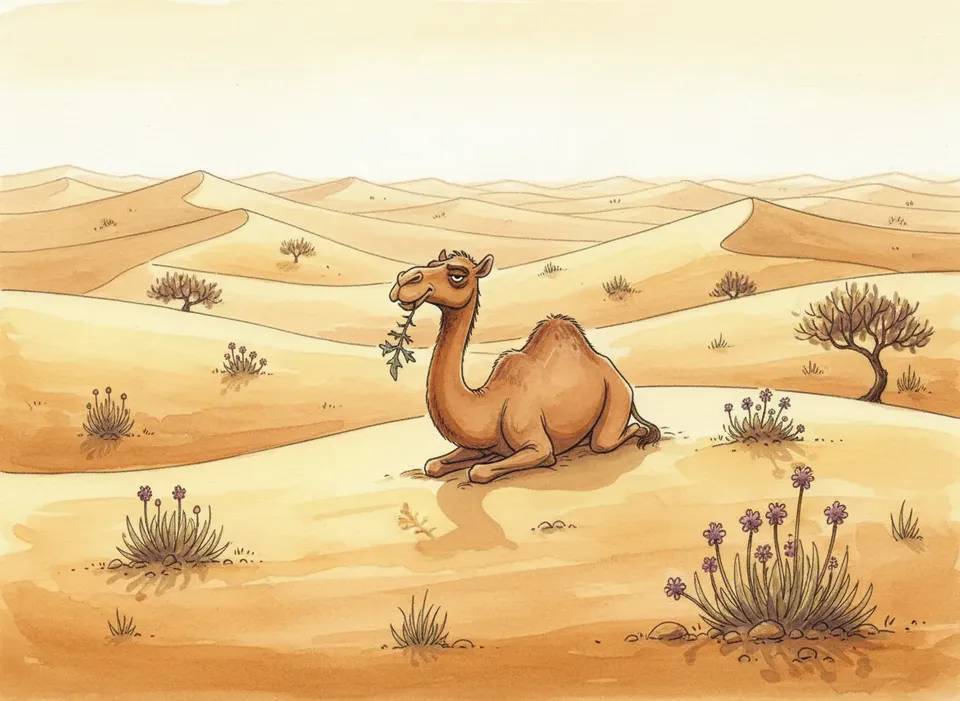
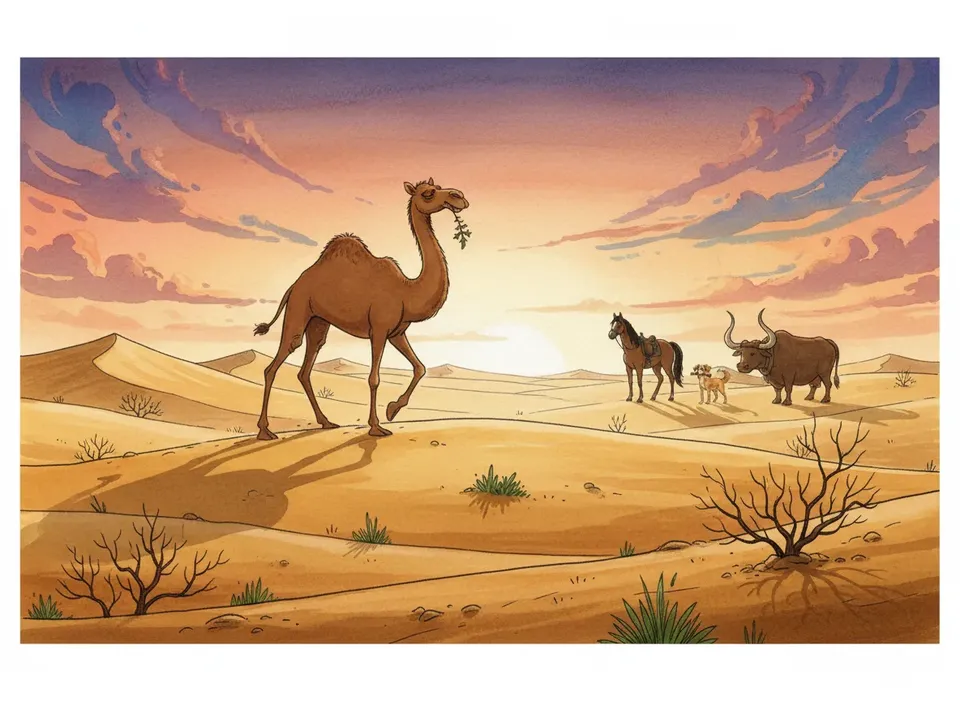
In the beginning of years, when the world was so new and all, and the Animals were just beginning to work for Man, there was a Camel, and he lived in the middle of a Howling Desert because he did not want to work; and besides, he was a Howler himself. So he ate sticks and thorns and tamarisks and milkweed and prickles, most ‘scruciating idle; and when anybody spoke to him he said ‘Humph!’ Just ‘Humph!’ and no more.
In the middle of the Howling Desert lived a very idle Camel.
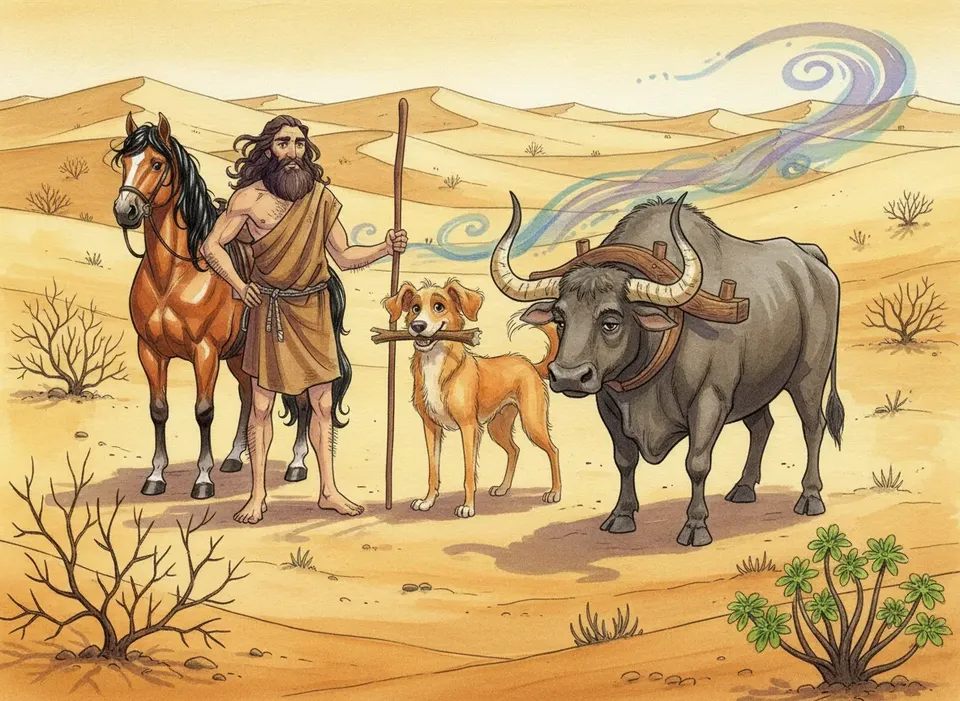
Presently the Horse came to him on Monday morning, with a saddle on his back and a bit in his mouth, and said, ‘Camel, O Camel, come out and trot like the rest of us.’
‘Humph!’ said the Camel; and the Horse went away and told the Man.
Presently the Dog came to him, with a stick in his mouth, and said, ‘Camel, O Camel, come and fetch and carry like the rest of us.’
‘Humph!’ said the Camel; and the Dog went away and told the Man.
Presently the Ox came to him, with the yoke on his neck and said, ‘Camel, O Camel, come and plough like the rest of us.’
‘Humph!’ said the Camel; and the Ox went away and told the Man.
At the end of the day the Man called the Horse and the Dog and the Ox together, and said, ‘Three, O Three, I’m very sorry for you (with the world so new-and-all); but that Humph-thing in the Desert can’t work, or he would have been here by now, so I am going to leave him alone, and you must work double-time to make up for it.’
The Man told the Horse, the Dog, and the Ox they must work double-time.
That made the Three very angry (with the world so new-and-all), and they held a palaver, and an indaba, and a punchayet, and a pow-wow on the edge of the Desert; and the Camel came chewing on milkweed most ‘scruciating idle, and laughed at them. Then he said ‘Humph!’ and went away again.
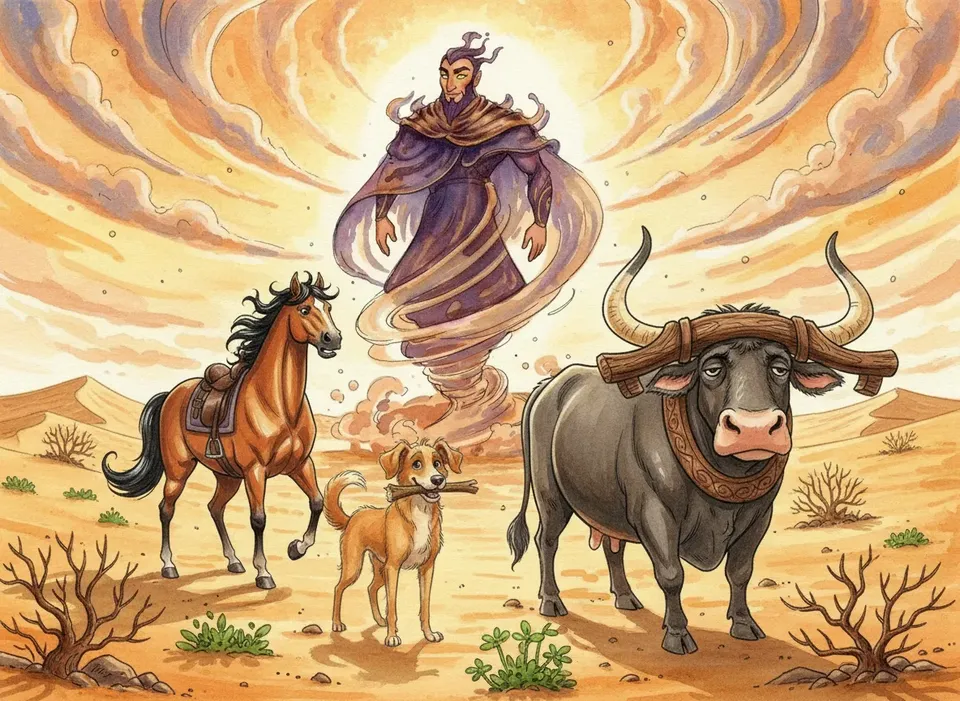
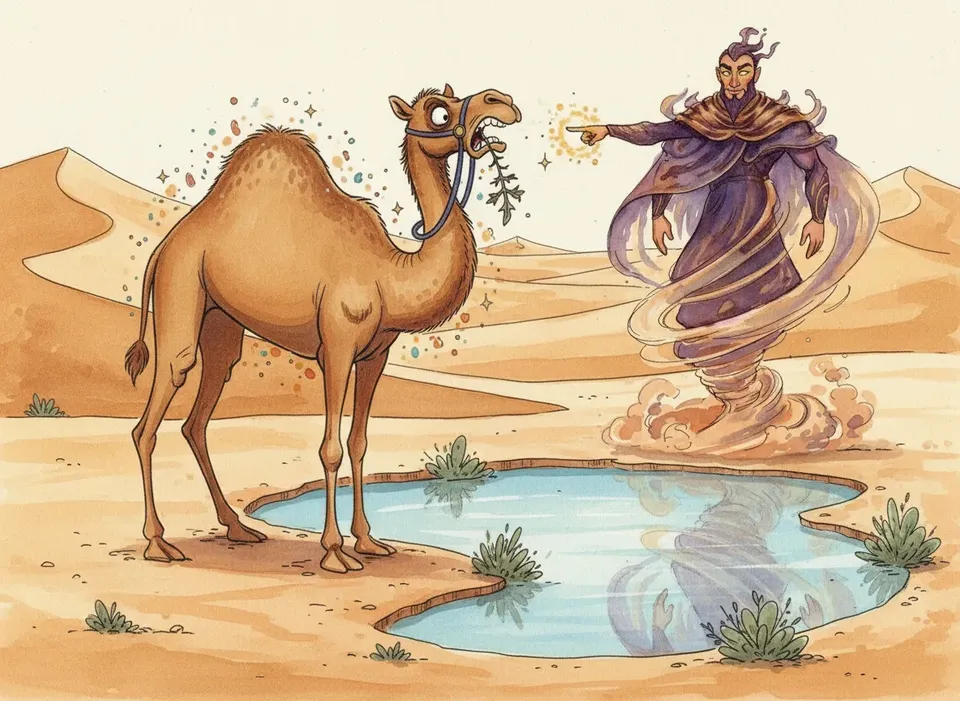
Presently there came along the Djinn in charge of All Deserts, rolling in a cloud of dust (Djinns always travel that way because it is Magic), and he stopped to palaver and pow-pow with the Three.
The Djinn of All Deserts arrived rolling in a cloud of magic dust.
‘Djinn of All Deserts,’ said the Horse, ‘is it right for any one to be idle, with the world so new-and-all?’
‘Certainly not,’ said the Djinn.
‘Well,’ said the Horse, ‘there’s a thing in the middle of your Howling Desert (and he’s a Howler himself) with a long neck and long legs, and he hasn’t done a stroke of work since Monday morning. He won’t trot.’
‘Whew!’ said the Djinn, whistling, ‘that’s my Camel, for all the gold in Arabia! What does he say about it?’
‘He says “Humph!”’ said the Dog; ‘and he won’t fetch and carry.’
‘Does he say anything else?’
‘Only “Humph!”; and he won’t plough,’ said the Ox.
‘Very good,’ said the Djinn. ‘I’ll humph him if you will kindly wait a minute.’
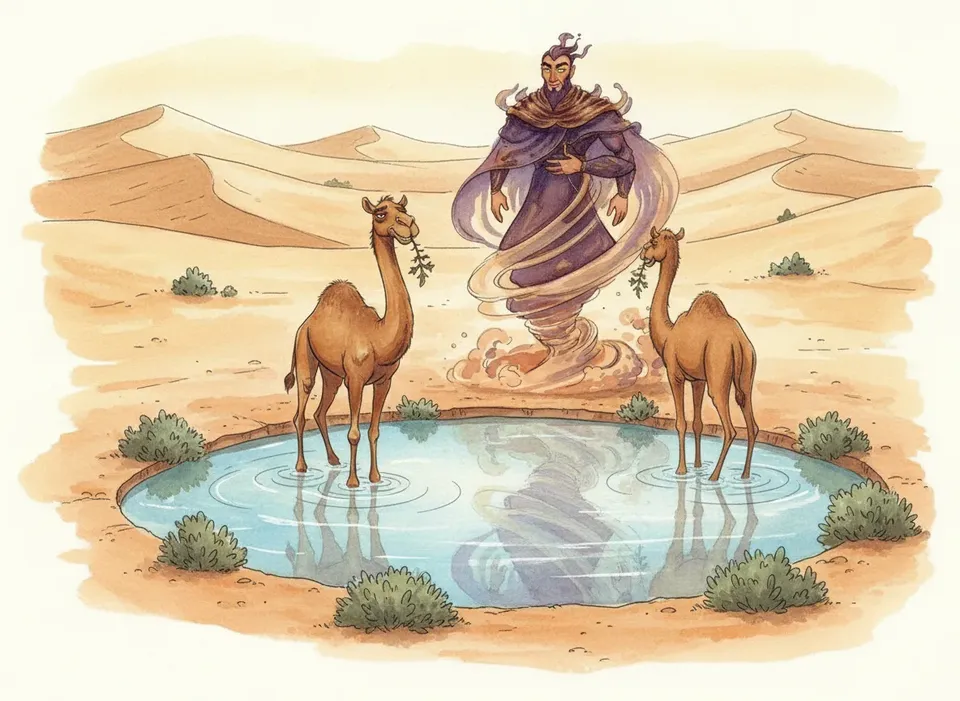
The Djinn rolled himself up in his dust-cloak, and took a bearing across the desert, and found the Camel most ‘scruciatingly idle, looking at his own reflection in a pool of water.
The Djinn found the Camel looking at his own reflection in a pool.
‘My long and bubbling friend,’ said the Djinn, ‘what’s this I hear of your doing no work, with the world so new-and-all?’
‘Humph!’ said the Camel.
The Djinn sat down, with his chin in his hand, and began to think a Great Magic, while the Camel looked at his own reflection in the pool of water.
‘You’ve given the Three extra work ever since Monday morning, all on account of your ‘scruciating idleness,’ said the Djinn; and he went on thinking Magics, with his chin in his hand.
‘Humph!’ said the Camel.
‘I shouldn’t say that again if I were you,’ said the Djinn; you might say it once too often. Bubbles, I want you to work.’
And the Camel said ‘Humph!’ again; but no sooner had he said it than he saw his back, that he was so proud of, puffing up and puffing up into a great big lolloping humph.
The Camel's back puffed up into a great big lolloping humph!
‘Do you see that?’ said the Djinn. ‘That’s your very own humph that you’ve brought upon your very own self by not working. To-day is Thursday, and you’ve done no work since Monday, when the work began. Now you are going to work.’
‘How can I,’ said the Camel, ‘with this humph on my back?’
‘That’s made a-purpose,’ said the Djinn, ‘all because you missed those three days. You will be able to work now for three days without eating, because you can live on your humph; and don’t you ever say I never did anything for you. Come out of the Desert and go to the Three, and behave. Humph yourself!’
And the Camel humphed himself, humph and all, and went away to join the Three. And from that day to this the Camel always wears a humph (we call it ‘hump’ now, not to hurt his feelings); but he has never yet caught up with the three days that he missed at the beginning of the world, and he has never yet learned how to behave.
The Camel went away to join the Three, wearing his new hump.
THE Camel’s hump is an ugly lump Which well you may see at the Zoo; But uglier yet is the hump we get From having too little to do.
Kiddies and grown-ups too-oo-oo, If we haven’t enough to do-oo-oo, We get the hump— Cameelious hump— The hump that is black and blue!
We climb out of bed with a frouzly head And a snarly-yarly voice. We shiver and scowl and we grunt and we growl At our bath and our boots and our toys;
And there ought to be a corner for me (And I know there is one for you) When we get the hump— Cameelious hump— The hump that is black and blue!
The cure for this ill is not to sit still, Or frowst with a book by the fire; But to take a large hoe and a shovel also, And dig till you gently perspire;
And then you will find that the sun and the wind. And the Djinn of the Garden too, Have lifted the hump— The horrible hump— The hump that is black and blue!
I get it as well as you-oo-oo— If I haven’t enough to do-oo-oo— We all get hump— Cameelious hump— Kiddies and grown-ups too!
Public-domain text, first published 1902. Illustrations and narration: original, by Lullabunny.
Questions to ask after reading
The Camel wouldn't trot or plough; he just stayed in the desert and said...
What did the Djinn use to travel across the desert to find the Camel?
How would you describe the Camel's attitude to someone who has not read the story?
Why did the Djinn make the hump store food and water for three days?
The Camel did not want to help his friends at first. What is a job you really like to help with at home?