A proud, woolly kangaroo with four short legs gets more than he bargained for when he asks the gods to make him special, leading to a wild, shape-shifting chase across Australia.
The Sing-Song Of Old Man Kangaroo is a story for children aged 4 to 9 by Rudyard Kipling, about 8 minutes to read aloud. Read it free online with a picture on every page, or listen to it read aloud: a calm one for bedtime.
In this classic origin tale, a proud Kangaroo demands to be made different and popular, leading a god to set a hungry Dingo on his tail. The resulting frantic chase across Australia explains how the Kangaroo got its long legs and hopping gait. It is a rhythmic, humorous story about the unexpected consequences of getting exactly what you ask for.
NOT always was the Kangaroo as now we do behold him, but a Different Animal with four short legs. He was grey and he was woolly, and his pride was inordinate: he danced on an outcrop in the middle of Australia, and he went to the Little God Nqa.
He went to Nqa at six before breakfast, saying, ‘Make me different from all other animals by five this afternoon.’
Up jumped Nqa from his seat on the sandflat and shouted, ‘Go away!’
He was grey and he was woolly, and his pride was inordinate: he danced on a rock-ledge in the middle of Australia, and he went to the Middle God Nquing.
He went to Nquing at eight after breakfast, saying, ‘Make me different from all other animals; make me, also, wonderfully popular by five this afternoon.’
Up jumped Nquing from his burrow in the spinifex and shouted, ‘Go away!’
He was grey and he was woolly, and his pride was inordinate: he danced on a sandbank in the middle of Australia, and he went to the Big God Nqong.
He went to Nqong at ten before dinner-time, saying, ‘Make me different from all other animals; make me popular and wonderfully run after by five this afternoon.’
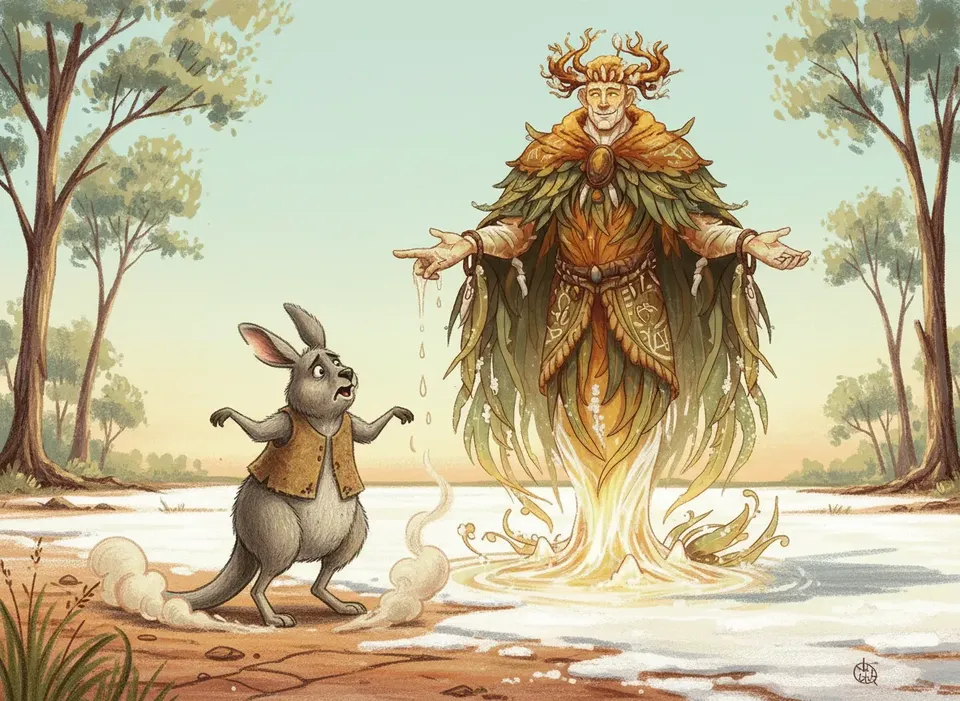
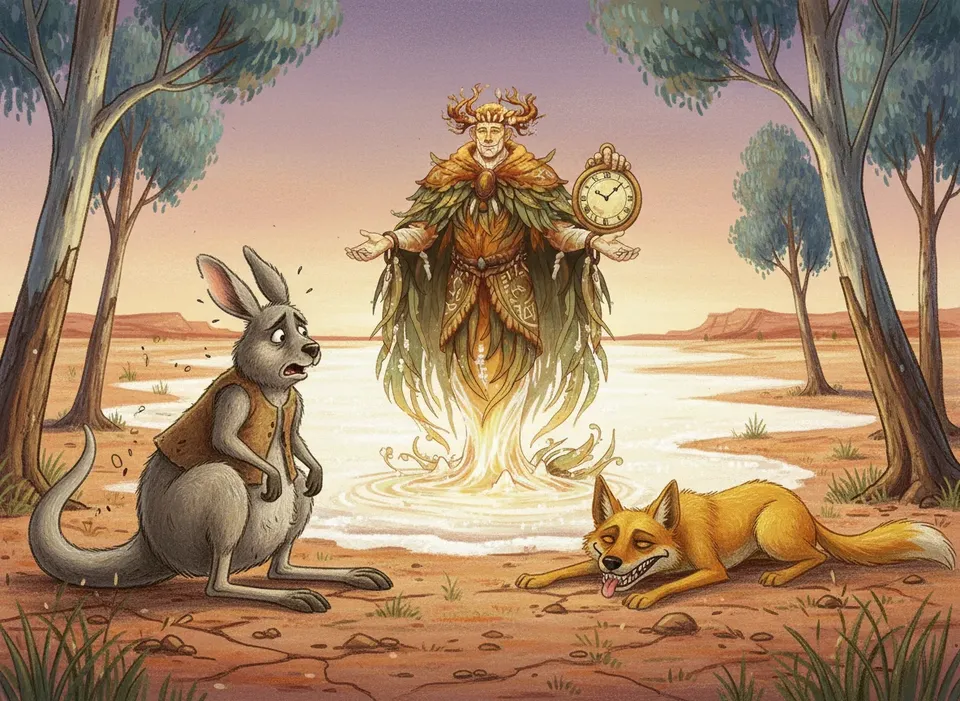
Up jumped Nqong from his bath in the salt-pan and shouted, ‘Yes, I will!’
The Big God Nqong jumped from his salt-pan bath and shouted, 'Yes, I will!'
Nqong called Dingo—Yellow-Dog Dingo—always hungry, dusty in the sunshine, and showed him Kangaroo. Nqong said, ‘Dingo! Wake up, Dingo! Do you see that gentleman dancing on an ashpit? He wants to be popular and very truly run after. Dingo, make him SO!’
Up jumped Dingo—Yellow-Dog Dingo—and said, ‘What, that cat-rabbit?’
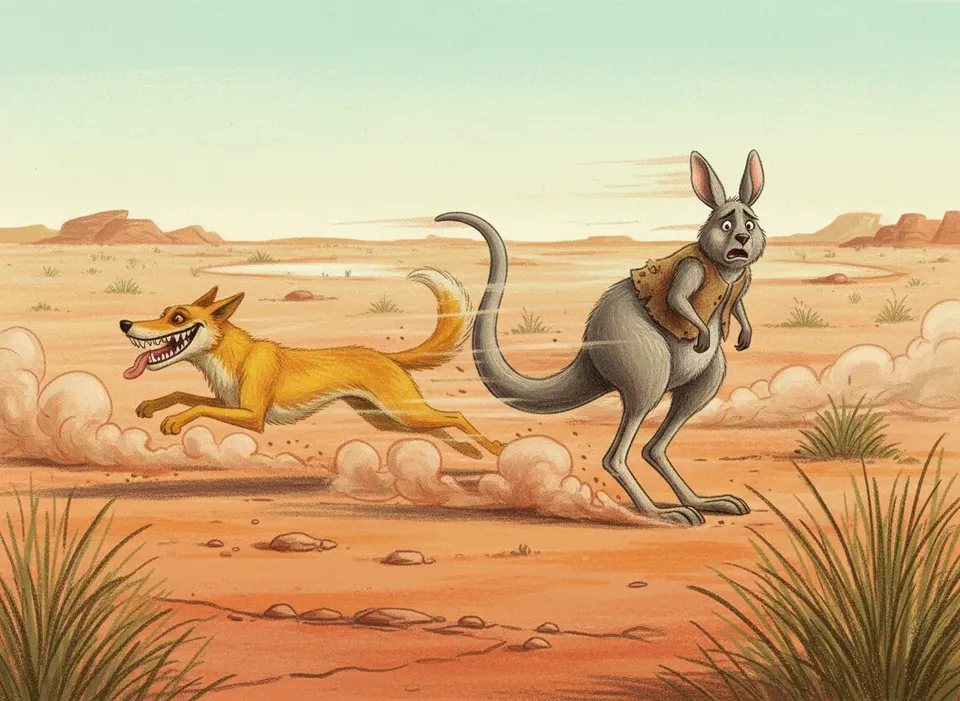
Off ran Dingo—Yellow-Dog Dingo—always hungry, grinning like a coal-scuttle,—ran after Kangaroo.
Off ran Yellow-Dog Dingo, always hungry, grinning like a coal-scuttle.
Off went the proud Kangaroo on his four little legs like a bunny.
This, O Beloved of mine, ends the first part of the tale!
He ran through the desert; he ran through the mountains; he ran through the salt-pans; he ran through the reed-beds; he ran through the blue gums; he ran through the spinifex; he ran till his front legs ached.
He had to!
Still ran Dingo—Yellow-Dog Dingo—always hungry, grinning like a rat-trap, never getting nearer, never getting farther,—ran after Kangaroo.
He had to!
Still ran Kangaroo—Old Man Kangaroo. He ran through the ti-trees; he ran through the mulga; he ran through the long grass; he ran through the short grass; he ran through the Tropics of Capricorn and Cancer; he ran till his hind legs ached.
He had to!
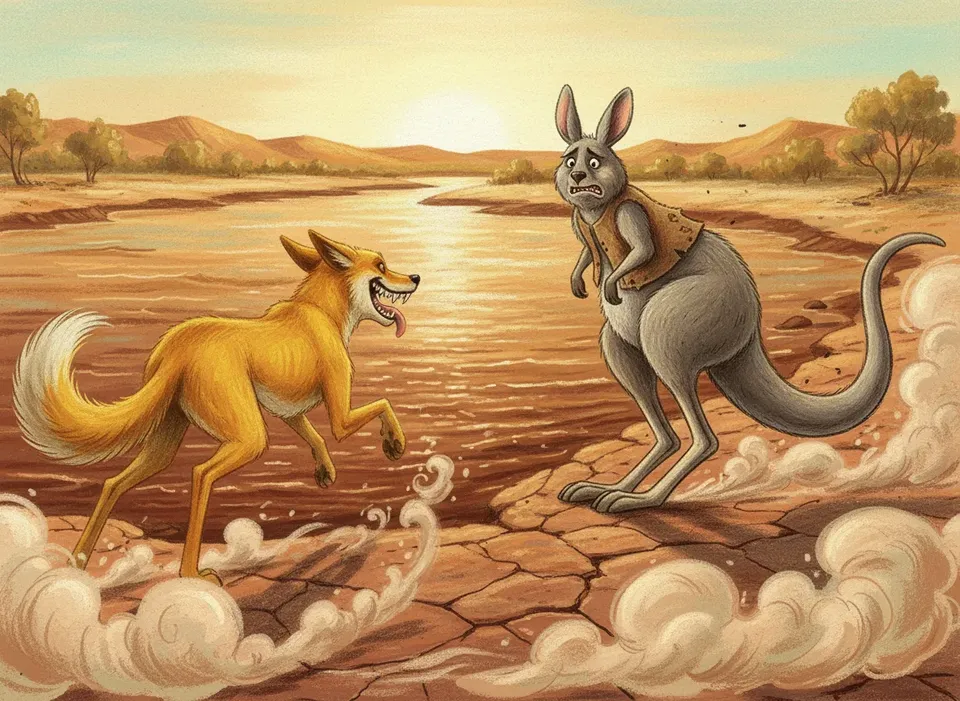
Still ran Dingo—Yellow-Dog Dingo—hungrier and hungrier, grinning like a horse-collar, never getting nearer, never getting farther; and they came to the Wollgong River.
Now, there wasn’t any bridge, and there wasn’t any ferry-boat, and Kangaroo didn’t know how to get over; so he stood on his legs and hopped.
He didn't know how to get over; so he stood on his legs and hopped.
He had to!
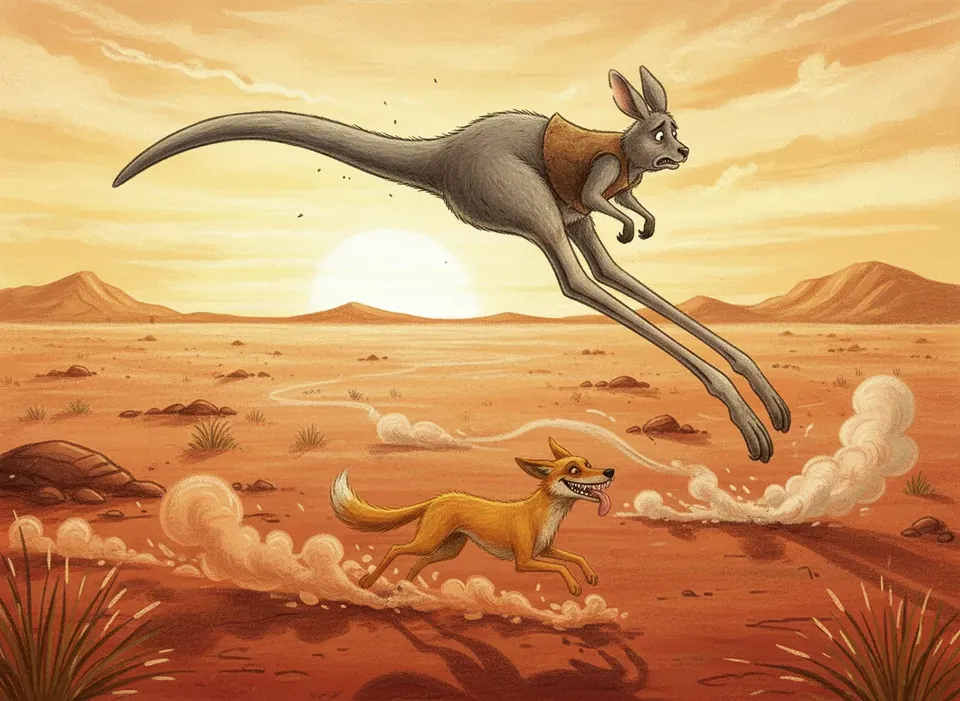
He hopped through the Flinders; he hopped through the Cinders; he hopped through the deserts in the middle of Australia. He hopped like a Kangaroo.
First he hopped one yard; then he hopped three yards; then he hopped five yards; his legs growing stronger; his legs growing longer. He hadn’t any time for rest or refreshment, and he wanted them very much.
Still ran Dingo—Yellow-Dog Dingo—very much bewildered, very much hungry, and wondering what in the world or out of it made Old Man Kangaroo hop.
For he hopped like a cricket; like a pea in a saucepan; or a new rubber ball on a nursery floor.
He had to!
He tucked up his front legs; he hopped on his hind legs; he stuck out his tail for a balance-weight behind him; and he hopped through the Darling Downs.
He tucked up his front legs and hopped on his hind legs!
He had to!
Still ran Dingo—Tired-Dog Dingo—hungrier and hungrier, very much bewildered, and wondering when in the world or out of it would Old Man Kangaroo stop.
Then came Nqong from his bath in the salt-pans, and said, ‘It’s five o’clock.’
Down sat Dingo—Poor Dog Dingo—always hungry, dusky in the sunshine; hung out his tongue and howled.
Down sat Kangaroo—Old Man Kangaroo—stuck out his tail like a milking-stool behind him, and said, ‘Thank goodness that’s finished!’
Down sat Kangaroo, stuck out his tail like a milking-stool, and said, 'Thank goodness that's finished!'
Then said Nqong, who is always a gentleman, ‘Why aren’t you grateful to Yellow-Dog Dingo? Why don’t you thank him for all he has done for you?’
Then said Kangaroo—Tired Old Kangaroo—He’s chased me out of the homes of my childhood; he’s chased me out of my regular meal-times; he’s altered my shape so I’ll never get it back; and he’s played Old Scratch with my legs.’
Then said Nqong, ‘Perhaps I’m mistaken, but didn’t you ask me to make you different from all other animals, as well as to make you very truly sought after? And now it is five o’clock.’
‘Yes,’ said Kangaroo. ‘I wish that I hadn’t. I thought you would do it by charms and incantations, but this is a practical joke.’
‘Joke!’ said Nqong from his bath in the blue gums. ‘Say that again and I’ll whistle up Dingo and run your hind legs off.’
‘No,’ said the Kangaroo. ‘I must apologise. Legs are legs, and you needn’t alter ‘em so far as I am concerned. I only meant to explain to Your Lordliness that I’ve had nothing to eat since morning, and I’m very empty indeed.’
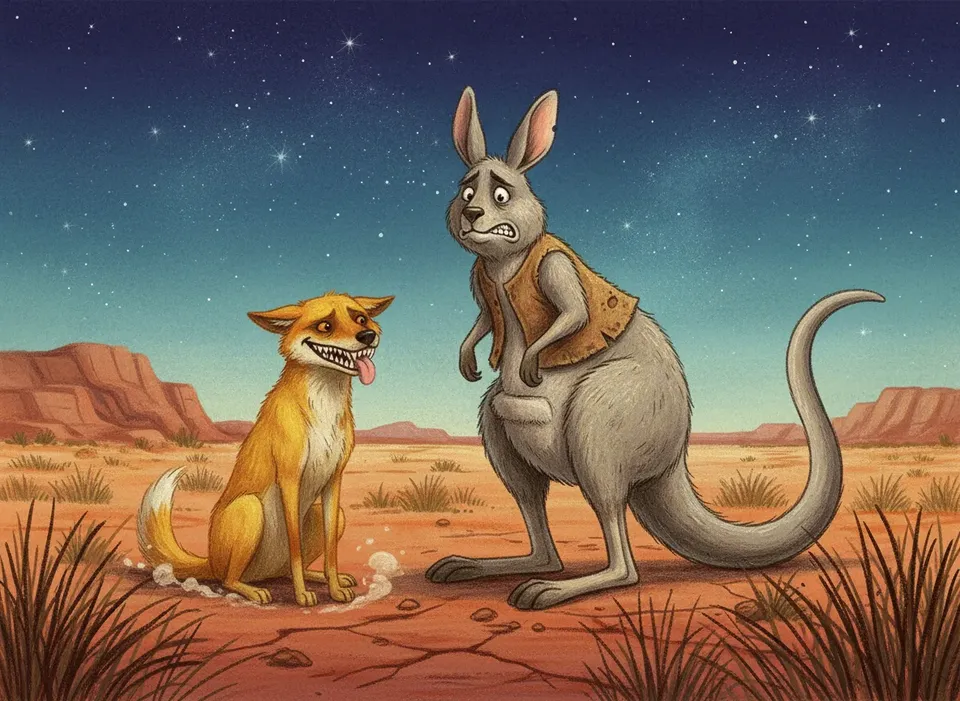
‘Yes,’ said Dingo—Yellow-Dog Dingo,—‘I am just in the same situation. I’ve made him different from all other animals; but what may I have for my tea?’
Then said Nqong from his bath in the salt-pan, ‘Come and ask me about it tomorrow, because I’m going to wash.’
So they were left in the middle of Australia, Old Man Kangaroo and Yellow-Dog Dingo, and each said, ‘That’s your fault.’
They were left in the middle of Australia, and each said, 'That's your fault.'
THIS is the mouth-filling song Of the race that was run by a Boomer, Run in a single burst—only event of its kind— Started by big God Nqong from Warrigaborrigarooma, Old Man Kangaroo first: Yellow-Dog Dingo behind.
Kangaroo bounded away, His back-legs working like pistons— Bounded from morning till dark, Twenty-five feet to a bound. Yellow-Dog Dingo lay Like a yellow cloud in the distance— Much too busy to bark. My! but they covered the ground!
Nobody knows where they went, Or followed the track that they flew in, For that Continent Hadn’t been given a name. They ran thirty degrees, From Torres Straits to the Leeuwin (Look at the Atlas, please), And they ran back as they came.
S’posing you could trot From Adelaide to the Pacific, For an afternoon’s run Half what these gentlemen did You would feel rather hot, But your legs would develop terrific— Yes, my importunate son, You’d be a Marvellous Kid!
Public-domain text, first published 1902. Illustrations and narration: original, by Lullabunny.
Questions to ask after reading
The story says that when the Dingo chased him, the Kangaroo didn't want to run, but 'He had...'
Which animal did the Big God Nqong ask to run after the Kangaroo to make him popular?
If you look at the Kangaroo's legs at the end of the story, how do they look different than they did at the beginning?
Why was the Kangaroo so upset with the God Nqong once it finally reached five o'clock?
The Kangaroo was very proud of himself at the start; what is something special you are proud that you can do?